How to Read Industrial Robot Model Numbers: FANUC, KUKA and ABB Explained
Decode FANUC R-2000iC/210F, KUKA KR 210 R2700-2 and ABB IRB 6700-200/2.60 segment by segment: payload, reach, generation and variant — and why the full model number matters when you order a robot dresspack.
A robot model number is not just a name. In most cases it tells you the robot's payload, its reach, which product generation it belongs to and which variant you are looking at. For line planning, spare parts and accessories such as robot dresspacks, reading it correctly is the first step.
This guide decodes three common heavy-payload six-axis robots in the 200–210 kg class, one from each of three major robot brands:
- FANUC R-2000iC/210F
- KUKA KR 210 R2700-2
- ABB IRB 6700-200/2.60
1. What a model number usually contains
| Segment | What it tells you |
|---|---|
| Series | Robot family and platform generation |
| Payload (kg) | How much the wrist can carry, which limits gripper and workpiece weight |
| Reach | Size of the working envelope, which drives cell layout |
| Suffix | Variant or generation: arm length, mounting type, product revision |
In short: the series sets the platform, the digits set the capability, and the suffix sets the exact version. Each brand arranges these segments differently, which is why the same robot class can look very different on paper.
2. FANUC R-2000iC/210F
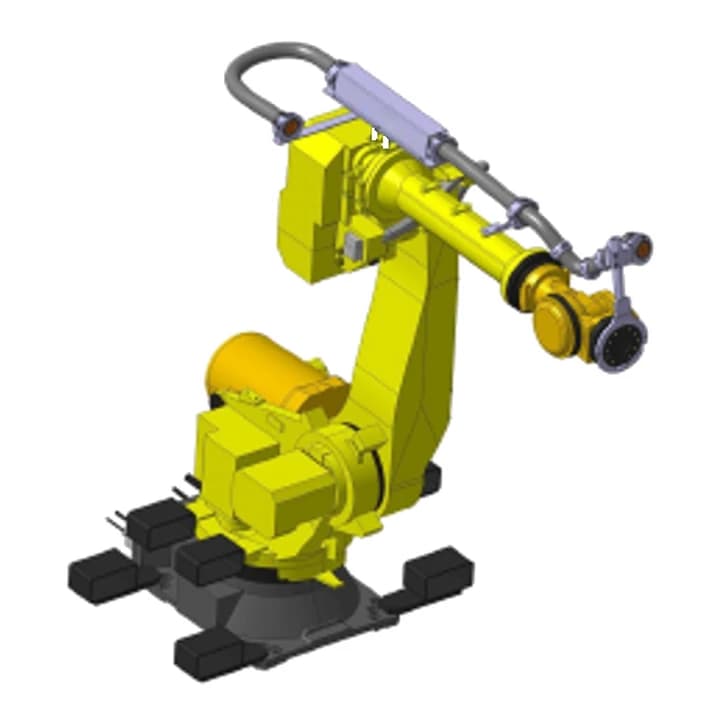 FANUC R-2000iC heavy-payload robot fitted with a robot dresspack
| Segment | Meaning |
|---|---|
| R-2000 | R-2000 series, FANUC's heavy-payload general-purpose robot family |
| iC | Platform generation (earlier generations were iA and iB, e.g. R-2000iB/210F) |
| 210 | Rated payload: 210 kg |
| F | Variant: the standard-arm version, with a reach of 2,655 mm |
Why the suffix matters: FANUC also builds the R-2000iC/210L, the long-arm version with the same 210 kg payload but a reach of 3,100 mm. Same series, same payload, but a different arm, so the two robots need different dresspacks.
3. KUKA KR 210 R2700-2
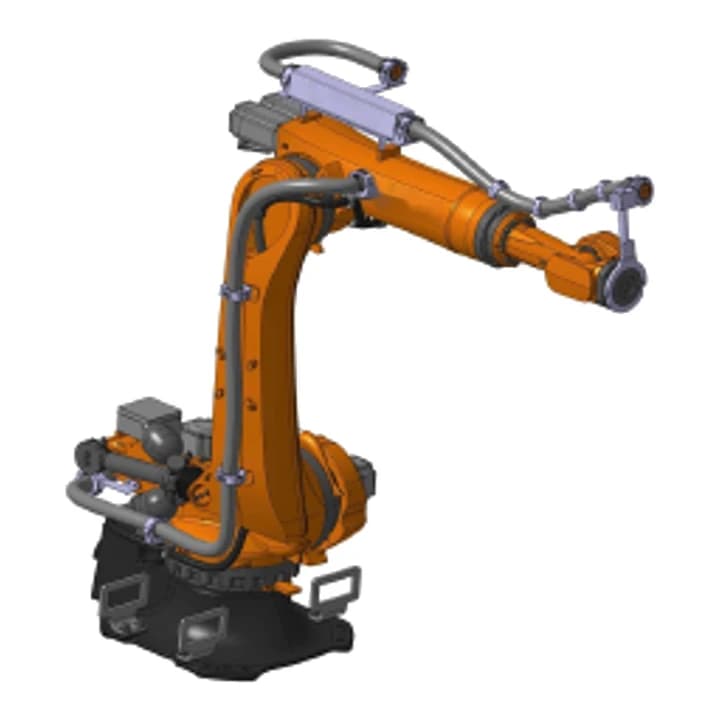 KUKA KR 210 heavy-payload robot fitted with a robot dresspack
| Segment | Meaning |
|---|---|
| KR | KUKA Robot |
| 210 | Rated payload: 210 kg |
| R2700 | Reach class: approx. 2,700 mm (maximum reach 2,701 mm) |
| -2 | Second generation of the KR QUANTEC family |
KUKA writes payload and reach directly into the model number, so the capability of the robot is readable at a glance. The generation suffix deserves attention: when you source spare parts or accessories for a used or replacement robot, always confirm which generation it is before ordering.
4. ABB IRB 6700-200/2.60
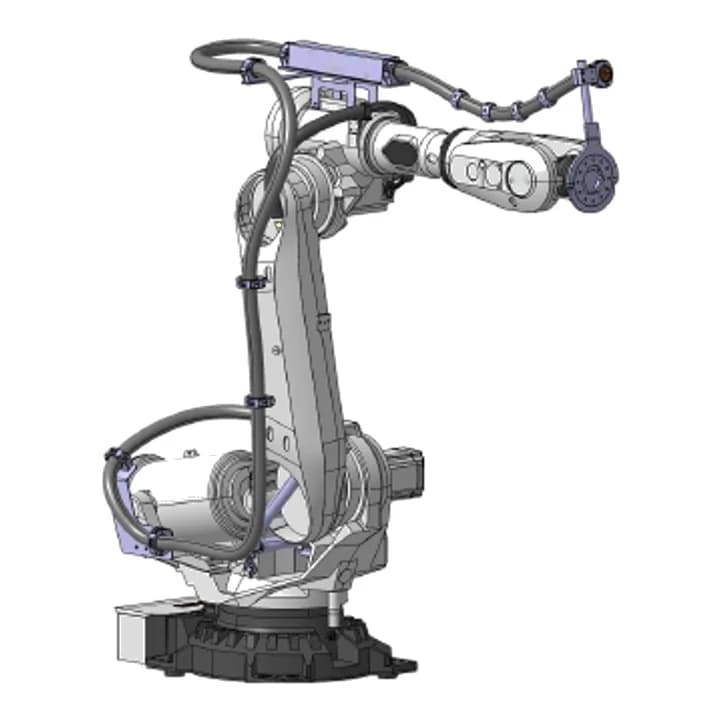 ABB IRB 6700 heavy-payload robot fitted with a robot dresspack
| Segment | Meaning |
|---|---|
| IRB | Industrial Robot |
| 6700 | IRB 6700 family, ABB's large-robot range |
| 200 | Handling capacity: 200 kg |
| /2.60 | Reach in metres: 2.60 m (2,600 mm) |
The IRB 6700 is a large family, so the numbers after the family name are essential. A few of the floor-mounted variants:
| Variant | Handling capacity | Reach |
|---|---|---|
| IRB 6700-150/3.20 | 150 kg | 3.20 m |
| IRB 6700-200/2.60 | 200 kg | 2.60 m |
| IRB 6700-235/2.65 | 235 kg | 2.65 m |
| IRB 6700-300/2.70 | 300 kg | 2.70 m |
A detail that matters for dresspacks: ABB lists a lower handling capacity for IRB 6700 robots fitted with its integrated LeanID dressing. The IRB 6700-200/2.60, for example, drops from 200 kg to 175 kg. How a robot is dressed is part of the load calculation, not an afterthought.
5. Side-by-side comparison
| FANUC | KUKA | ABB | |
|---|---|---|---|
| Example model | R-2000iC/210F | KR 210 R2700-2 | IRB 6700-200/2.60 |
| Rated payload | 210 kg | 210 kg | 200 kg |
| Maximum reach | 2,655 mm | 2,701 mm | 2,600 mm |
| Where payload appears | After the slash | After "KR" | After the family number |
| Where reach appears | Implied by suffix (F / L) | "R" + mm | After the slash, in metres |
| Generation shown by | Letters after "i" (iA, iB, iC) | Suffix "-2" | Family number |
All three are direct competitors in the 200–210 kg / 2.6–2.7 m class and are often found on the same production lines, especially for spot welding and heavy handling.
6. Quick decoding rules
- FANUC R-2000iC/210F → R-2000 series, iC generation, 210 kg, standard arm (F)
- KUKA KR 210 R2700-2 → 210 kg, ~2,700 mm reach, second generation
- ABB IRB 6700-200/2.60 → IRB 6700 family, 200 kg, 2.60 m reach
7. Selection checklist
- Check the load diagram, not just the rated payload. Payload ratings depend on the centre of gravity and inertia of the tool. KUKA, for example, states that the KR 210 R2700-2's maximum payload of 275 kg only applies with the centre of mass at 0 mm. Include the gripper, the workpiece and the dresspack in your load case.
- Check reach against the farthest point the tool centre must reach, including the length of the end-effector.
- Confirm the full suffix (variant and generation) before ordering spare parts or accessories.
- Confirm controller compatibility with the existing line: teach pendant, programming language and communication protocols.
Why the full model number matters for your dresspack
A robot dresspack is designed around one specific arm: its link lengths, its joint positions and the mounting points on the robot. Hose length, bracket positions and the return system all follow from that geometry. As the FANUC example shows, two robots with the same series and payload can have very different arms.
When you request a dresspack quote, always send the complete model number, including every suffix. A nameplate photo works too.
Fadeya designs and builds custom robot dresspacks for ABB, KUKA, FANUC, YASKAWA, Kawasaki and other brands, as well as for collaborative robots.
- Browse Robot Dresspack products
- Replacing a LEONI / BizLink proflex hose? See the LEONI cross-reference
- Robot Dresspack Hose Sizes Explained
- Need a custom dresspack? Request a quote
FANUC, KUKA, KR QUANTEC, ABB and LeanID are trademarks of their respective owners. Fadeya is not affiliated with these companies. Technical data is taken from the manufacturers' published specifications for reference only; please check the manufacturer's current data sheet before planning a cell.